
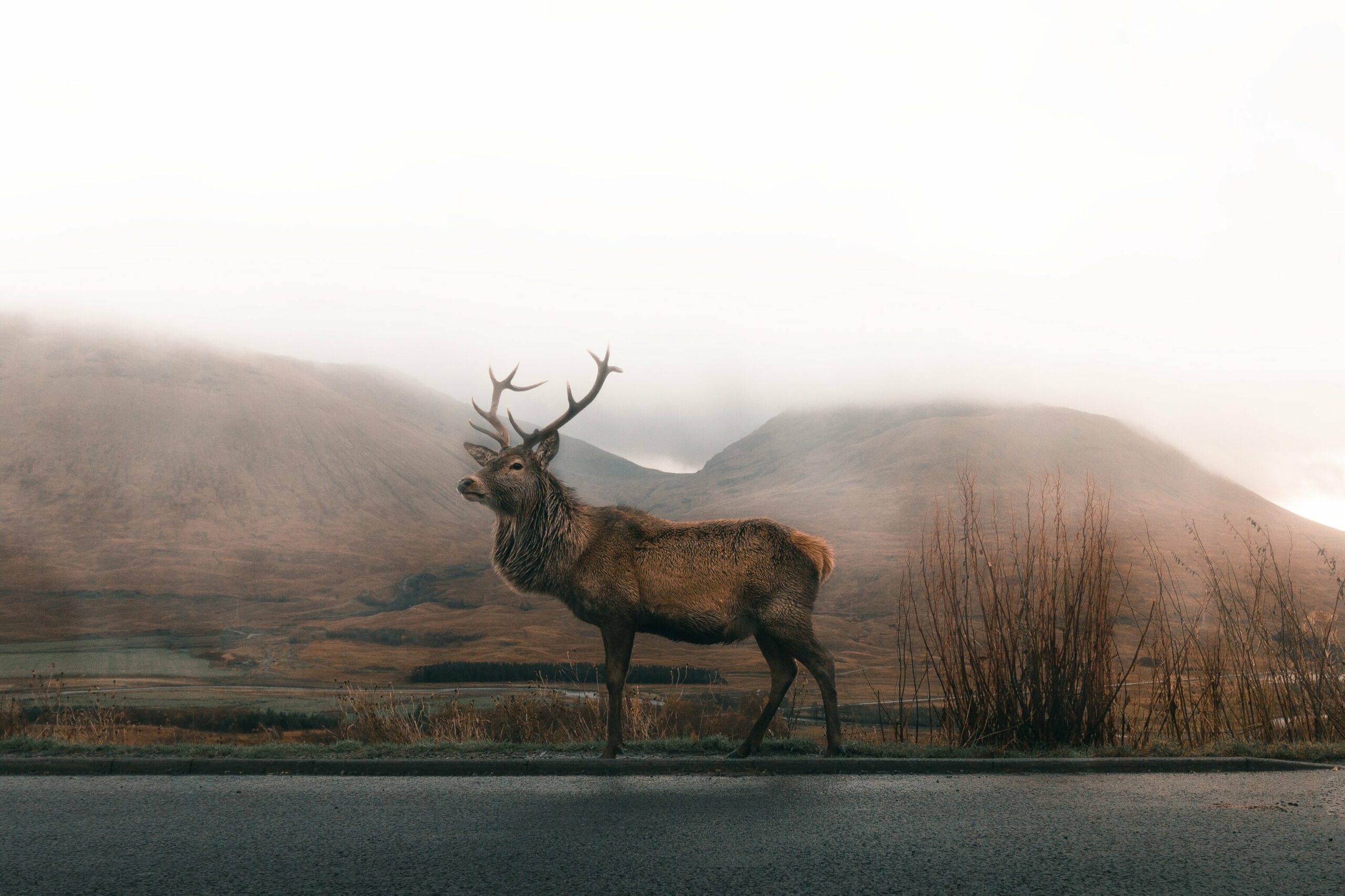
The Columbian Blacktail Deer
By Dan Gibson

For many years the Columbian Blacktail Deer has been considered a subspecies of the Mule deer, however recent DNA testing has proven this not to be the case. In Valerius Geist's informative book Mule Deer Country he explains that by testing the mitochondrial DNA (the mothers DNA ) of the three species (blacktail, whitetail and mule deer), researchers have now determined that it was the mating of Whitetail does and Blacktail buck's that gave rise to the Mule deer and not the opposite as was once suspected.

It is now believed that millions of years ago the Whitetail deer expanded its range down the east coast of the United States, across Mexico, and then back up the West coast, where it eventually evolved into the Blacktail Deer. This may help to explain the strong resemblance in appearance and psychological characteristics between the two. Thousands of years later as the recently evolved Blacktail's range spread eastward and the Whitehall's range again expanded westward, the two deer again met. At this point the Blacktail bucks, displaced the Whitetail bucks, and bred the Whitetail does. Researches now believe that it is this hybridization that produced what is now know as the Muledeer.

For those of you not familiar with the Columbian Blacktail, their range, as recognized by Boone and Crockett (B&C), extends form central British Columbia, south to the Monterey Bay in California. Columbian Blacktails inhabit a narrow strip of land from the shores of the pacific ocean inland for approximately a hundred miles. This distance will of course vary from location to location

In regards to the geographic boundaries of the Columbian Blacktail one must rely on the observations of wildlife biologists, graduate students and scientists, who have done extensive scientific research and identification on the Columbian Blacktail and it's range. I wish it was as simple as having years of hunting experience in order to be able do identify the possible genetic make-up of a particular deer, but unfortunately it isn't. This is why DNA is such an important tool in deer identification.

When I refer to the boundaries of the Columbian Blacktail, I am referring to the recognized Boone & Crockett boundaries. B&C's boundaries are not the exact boundaries of the Columbian Blacktail, they have actually been moved slightly inward to help reduce the possibility of hybridization with Muledeer or Muledeer/Blacktail crosses.
Since we are a hunting website these are the boundaries we recognize.

There are undoubtedly pure Columbian Blacktails in other area's but because of possible hybridization, they are not considered pure Columbian Blacktails by B&C. Just because a buck appears to be 100% Columbian, doesn't mean that generations ago there wasn't a Muledeer in his heritage.

Blacktail deer on average are smaller than their Whitetail and Muledeer cousins. Here in my north western California a 140 pound buck (live weight) is considered very good size. Blacktail bucks do occasionally approach 200 pounds, but from my experience, it's a very rare occurrence. Years ago I killed a huge bodied forked horn in San Joaquine county that tipped the scales at 171 pounds field dressed. To date this buck is the largest Columbian Blacktail I have ever personally witnessed.

Although I do not have a lot of experience with Oregon Blacktails I am told they are slightly larger in body size than the California bucks. Washington on the other hand produces some very large bodied Blacktails. If my experience with this website is any indication, it appears that bucks weighing 175 lb. field dressed are not that uncommon in the "Evergreen state".

Horn size in Blacktails runs contrary to what one might expect and is an often debated topic among Blacktail hunters. In the Columbian Blacktail body size appears to have little relationship to horn size. This is generally not the situation with Whitetail and Muledeer. In their case, body size and antler size are closely related and as a rule of thumb both get larger as you travel north. The larger the body the larger the antlers. This becomes very evident when you compare a Florida Whitetail to a Michigan Whitetail, or a Desert Mule Deer to a Rocky Mountain Mule Deer.

In the case of the Columbian Blacktail this circumstance does not apply. California, the southern most state in the Columbian Blacktails range, has produced more B&C Blacktails than either Oregon or Washington. One would think that the opposite would be true but the record books state the fact clearly. The largest racked Columbian Blacktails are found in the southern portion of their range. Even though California and Oregon regularly produce higher scoring bucks than Washington. The current world record comes from Washington state. Obviously California and Oregon are not the only areas capable of producing huge Blacktails.

Click for larger view
Although the bucks pictured on this page are definitely nice, only two or three
would qualify for Boone & Crockett.

Many hunters look at the field photos section of BlacktailCountry.com and are amazed at the size that Columbian Blacktails are capable of attaining. A few have even gone as far a accusing me of posting photos of Muley's or Muley crosses. If you're in doubt, I suggest you take a look at these numbers compiled from Boone and Crocketts Records of North American Deer and Elk and Decide for yourself.

Even though Blacktails hunters readily agree that there are areas well known for producing large Muledeer bucks, such as the Paunsaguant, the "Arizona strip" and the "Grande Mesa" in Colorado. Many have a hard time believing the same holds true for the Columbian Blacktail. Often saying that the Blacktails that come out of northern California and southern Oregon are not true Columbian's, but rather a muley cross. Their reasoning is simply? They can't be Blacktails because they have never seen a buck that size in their hunting area. The truth of the matter is, the rule of good genetics and nutrition, also applies to the Blacktail.

Hunting the Columbian Blacktail

Anyone who has hunted Blacktails knows what a difficult proposition it can be. Blacktails are every bit as sneaky as their ancestors, the Whitetail. There are even those that claim there is no comparison between the two, saying without a doubt, the Blacktail is the most difficult deer species of all to hunt. This is not meant to diminish the Whitetail's intelligence, on the contrary. There are many other factors that must be considered when determining how difficult a particular type of deer is to hunt.

In my opinion the most significant difference between Whitetail and Blacktail hunting is the time of year the seasons most often take place. Like deer hunting of all types weather conditions play a huge part in hunter success in Blacktail Country. Here in the northern portion of California's vast A-Zone, the archery season opens in mid July, with the rifle season opening one month later. At that time of the year, temperature are often in excess of 100 degrees. When it's that hot, Blacktail bucks rarely move during daylight hours but instead do most of their moving under the cover of darkness. Many hunters wouldn't even bother hunting in such conditions, but if you want an A-Zone Blacktail you don't have much choice. You either buck the heat or go home empty handed.

California's B-Zones, which open in mid September and run through late October occasionally offer a little relief from the heat but there is no guarantee. Oregon and Washington's Blacktail seasons aren't much better, regularly taking place when temperatures are high, but both states have limited late season hunting opportunities available. Washington has a split season which often gives hunters a chance to take advantage of cooler temperatures and the onset of the rut. Oregon also offers limited rut hunting opportunities.

If you get lucky and it rains before the season ends or there is a prolonged drop in the temperature, the bucks just might begin chasing the does. That was exactly what happen last year during a California B-Zone hunt. In 3 days of hunting we took five bucks with spreads in excess of 20 inches and I can't tell you how many others we passed up.

Weather's Effect on Blacktail Hunting.

If Blacktail season is open and it rains, drop everything and go buck hunting. One rainy morning last season I took a quick drive around the ranch and saw 33 deer in about an hour, with twelve of them being bucks. It was still early in the season so I never fired a shot. By the end of the season I was really regretting my decision, as I never again saw the big rain-soaked 4x3 that stared at me through the early morning mist. That's just how Blacktail hunting goes, they're everywhere one day and they're gone the next

Another factor that makes Blacktails so difficult to hunt is that Blacktail hunters rarely get to take advantage of the rut. Most seasons in California are set so they end before the rut begins but there are a few late season draw hunts available if you are lucky enough to pull a tag.

Oregon and Washington also have limited rut hunting available for Blacktails. Both states offer late draw season hunts for a variety of weapons. Washington general split season also gives hunters the possibility of getting a shot at a trophy class Blacktail buck during the rut.

Click for larger view
Many hunters have never seen Columbian Blacktails of this caliber, leading
them to believe they simply don't exist.

Blacktail Hunting Techniques

Blacktail bucks especially the mature ones, love the brush and don't often leave it during daylight hours. I am out on our ranch nearly everyday so I learn to recognize many of our bucks by sight. Before the season opens when the bucks are still in velvet they are very visible, often feeding on the open slopes in large bachelor herds (a group of bucks.) At that time of year Blacktails would appear very easy to hunt, but once their velvet is shed they become a different animal. They stick to the brush and travel very little during daylight hours. Many of the bucks I have watched all spring are never seen again until the rut begins. It is not hunting pressure that causes them to disappear, it is simply their nature. Even in areas with no hunting pressure the bucks fade into the landscape with the shedding of their velvet. During the season you may occasionally see younger bucks out feeding in the open , but it is rare that a mature Blacktail finds himself in that situation.

One very successful way to hunt Blacktails is by making drives through thick cover. A good drive usually requires several hunters. If you have the people, it can be a very effective method. One important thing to remember is that Blacktails will often hold tight and let you walk right by, once you have passed they will sneak out the back and the hunter will never know they were there.

The best buck taken off of our property to date was killed using this technique. After the drive was over a hunter who had stayed behind to "watch the back door", took an extremely heavy horned, 26 inch wide 3x3, as it snuck out behind the drivers, this is exactly why it's always a good idea to leave someone behind.

My favorite method of hunting Blacktails is to find a good vantage point, get in place before the sun comes up, and wait for the bucks to move. Blacktails often bed at the edges of thick cover. When the sun reaches their bedding areas they will get up and move to another shaded location. Most of the time they will only move a short distance but for a moment or two they are visible. Once you have located them you can then begin your stalk.

Occasionally when the weather is cool, or at first light, you will catch bucks crossing from one area to another. I have also noticed that the bucks in our area will often move again around nine or ten o'clock. When Blacktail bucks travel they often use broken ground or rocky slide areas as main travel routes. These of course are good places to ambush a buck.

I have personally not had much luck watching water holes. Blacktails have lived in these conditions for a long time and don't require much water daily. The majority of their water is obtained from small seeps back in the brush which I have seen them slip in and out of so quietly and quickly they leave you questioning what you have just seen. You will probably see deer if you watch a open waterhole, but you most likely won't see many mature bucks.

Horn rattling is also an effective technique to use on Columbian Blacktails. Every year numerous hunters use the tactic successfully. It is obviously more productive in areas where seasons take place during the rut or pre-rut. If you are in one of those areas I suggest you give it a try.

Many hunters have never seen Columbian Blacktails of this caliber, leading
them to believe they simply don't exist.

Even though Blacktails are difficult to hunt the serious Blacktail hunters often get their buck and many of them take two a year (where permitted), not to mention passing on countless others.

More than half of the deer pictured on my website BlacktailCountry.com were taken on public land. If you are willing to put in the effort and do your research. I am sure you will find Columbian Blacktail hunting to be a difficulty, but rewarding experience, and every bit as challenging, if not more, than any other big game animal you have ever hunted.

Trophy Potential

Many hunters underestimate the trophy potential of the Columbian Blacktail. There are without a doubt exceptional Blacktail bucks to be found through out their range but the Boone and Crockett (B&C) record book has proven that Northern California and Southern Oregon are the places to go for truly big Columbian Blacktails. I had been hunting Blacktails for close to 20 years and had taken some respectable bucks, but it wasn't until I moved to Mendocino county twelve years ago that I found out just how big pure Columbian Blacktails can really get.

I grew up a hundred and fifty miles South of here, hunting in the hills of San Joaquin and Alameda counties. Where rarely did we encounter truly big Blacktails. We considered a 16-inch wide, 3-point, an exceptional and difficult trophy, and it is, in San Joaquin County. But here in Mendocino County it would only be considered a little better than average. There were most certainly bigger bucks in the area but they were few and far between.

In Mendocino County a 16-inch buck is still a nice trophy, but not all that uncommon. We spend a lot of time every year filming and hunting Blacktails on our ranch and surrounding areas. Every year we see hundreds of bucks in that class. "Big" in this part of Blacktail Country starts at about 20 inches wide (outside) and 16 inches high. With at least three points per side and lots of mass.

A "really big" Blacktail will have a spread in excess of 24 inches, brow-tines and four or more points per side. Every year in our area there are Blacktails killed with spreads approaching 30 inches and others with numerous points and extreme mass. The number one Columbian Blacktail from the state of California (according to the Boone and Crockett Record Book) has an outside spread of 30 5/8 inches and an inside spread of 26 5/8 inches. Another huge Columbian Blacktail taken in Trinity County California, has an incredible outside spread of 35 3/8 inches and an inside spread of 28 6/8 inches.

Many bucks in fact do not make the book because of the deductions that excessive width can cause. I have no idea how many of these type bucks are taken every year but the numbers must be considerable. One thing I do know is that twenty plus inch wide Columbian Blacktails are much more common than many hunters realize.

If you are in search of a truly exceptional Blacktail and an incredible hunting experience, give Northern California a try. There is lot's of public land available for hunting and most of it holds trophy class Blacktails. For those of you who can afford to pay the price, there are also limited hunting opportunities available on private land with the average price for a fully guided Blacktail hunt costing in excess of three thousand dollars.

If you have never spent a morning sitting on a mountain top glassing the canyons below, or found yourself sneaking through the fern jungles of the west's coastal rain forests, you have missed out on a one of a kind hunting experience. If you have you will likely never forget the sights, sounds and smells of the west coasts awesome Blacktail Country.

Dan Gibson
BlacktailCountry.com

.

Blacktail Country Video Series

See for Yourself. B&C Break Down of Columbian Blacktail Antler "Spreads"
Return to Blacktail Country Home Page
Blacktail Articles Index